Reading the Fee Line on a 1,219 TH/s Monthly Statement
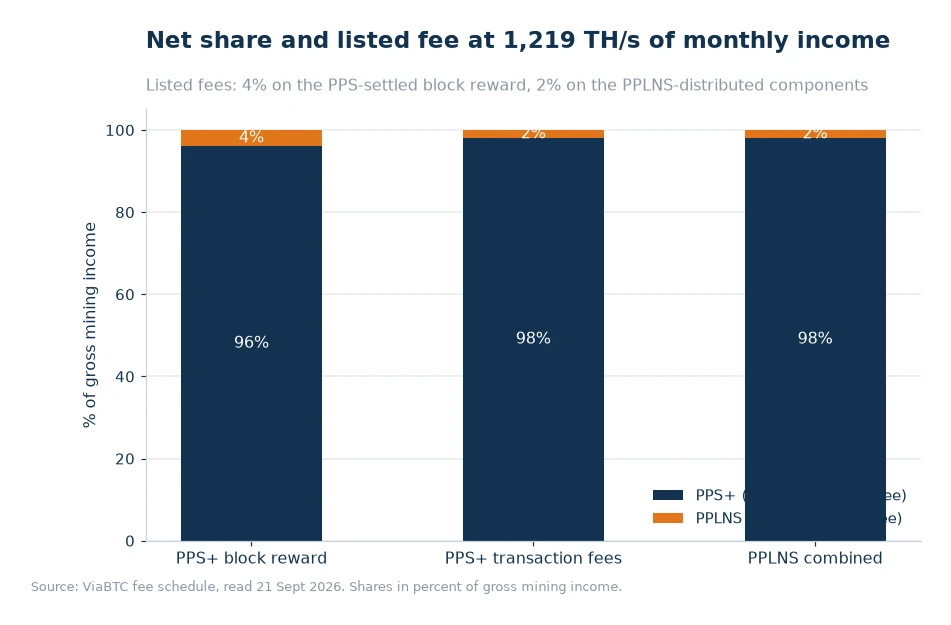
A rate card is a promise about percentages; an invoice is what those percentages took. At 1,219 TH/s the gross is $46.31 a day, so the listed 4% on the block-reward component comes to $1.85 and the listed 2% on the PPLNS-distributed components comes to $0.93. Over 30 days that is the difference between $1,333.85 and $1,361.64 reaching your wallet.

Key takeaways
- 1,219 TH/s produces about 0.00054686 BTC a day, or $46.31 at $84,692 per BTC.
- The listed 4% applies to the block-reward component only, which is $1.85 a day on this gross.
- The listed 2% applies to the PPLNS-distributed components, or $0.93 a day on the same gross.
- Over a 30-day month the two lines differ by $27.79, enough to matter on a single rack.
One rate card, two separate deductions
The first thing to unlearn is the idea of a single pool fee. PPS+ splits income into a block-reward part and a transaction-fee part, and it charges a different listed rate on each. The block-reward part is settled at 4%; the transaction-fee part is distributed on PPLNS logic at 2%. Neither number is a discount you negotiate and neither is a hidden charge. They are two line items attached to two kinds of income.
That structure exists because the two parts carry different risk. The block-reward component is paid against current difficulty without waiting for the pool to find a block, so the pool absorbs the variance. The transaction-fee component follows the PPLNS path, where the miner's slice is shared across the last five difficulty rounds after six confirmations. Different exposure, different listed rate.
Timing is the other half of the story. PPS+ settles the block-reward portion hourly, which means a rack of this size sees roughly 24 credits a day rather than one lump after a lucky block. A statement built from hourly credits is easier to reconcile against a power meter, because both series move in the same rhythm. Miners who have only used PPLNS often notice the change in cadence before they notice the change in rate.
Why the percentages never add up to six
Adding 4% and 2% is the most common arithmetic error in mining accounting, and it survives because the answer looks plausible. The rates do not apply to the same base. A miner whose income is almost entirely block reward pays close to 4%, not 6%. A miner whose window happens to be fee-heavy pays more of the 2% line. The blended rate sits somewhere between, and it moves with the mix rather than with the calendar.
This matters when you compare two pools. One may advertise a headline number that looks lower while applying it to the whole gross, and another may look higher while applying its rate to a narrower base. Converting both to dollars per day at your own hashrate is the only comparison that holds. A percentage quoted without its base is not a price.
A thirty-day view of the deduction
Daily figures are easy to dismiss; monthly figures are the ones that fund or drain a rack. The table below keeps the gross fixed at the 1,219 TH/s rate so that only the rate and its base change between rows.
| Line | Base over 30 days | Listed rate | Deduction | Net after the line |
|---|---|---|---|---|
| Gross before any deduction | $1,389.43 | none | $0.00 | $1,389.43 |
| Block-reward component under PPS+ | $1,389.43 | 4% | $55.58 | $1,333.85 |
| PPLNS-distributed components | $1,389.43 | 2% | $27.79 | $1,361.64 |
| Gap between the two lines | — | 2 points | $27.79 | $27.79 |
The final row is the honest measure of what the higher listed rate buys: certainty about when the block-reward income arrives. Whether that is worth $27.79 a month at this size is a judgment about cash flow, not a judgment about the pool.
Two habits make the table reusable. First, recompute the gross whenever difficulty moves, because a 30-day projection built on an old difficulty is a projection of a different machine. Second, keep the base column visible. A deduction of $55.58 means one thing against $1,389.43 of gross and quite another against a month shortened by a week of downtime.
Where the daily money actually lands
No real month is pure block reward. Transaction fees arrive in bursts, and a busy week can push the fee component from a rounding error to a visible share of income. When that happens, part of the gross moves from the 4% line to the 2% line, and the blended rate falls without the rate card changing at all. A miner who tracks only the headline percentage will read that as a discount and be confused when the dollar deduction is barely different.
The practical response is to record the component split each month rather than only the total. Three columns — block-reward income, fee income and total deduction — are enough to explain a movement that otherwise looks arbitrary. After a few months the pattern becomes familiar: the fee line is steady, the fee component is lumpy, and the total is the sum of a predictable part and a noisy one.
Where the daily money actually lands
After the deduction the credit appears in the account and can stay there. Mining payouts carry no withdrawal fee, so the net figures in the table are also the amounts that move to a wallet when you ask them to. That is worth stating because withdrawal charges are the usual place a fee estimate goes wrong on other platforms, and here the estimate stops at the listed rate.
The account itself holds a multi-currency wallet, which means the BTC from this rack does not have to leave in BTC. Converting it, holding it, or using it as collateral for a loan are all decisions made after the fee line, and none of them change what the pool deducted.
One more line belongs on the statement even though the pool does not print it: the flat cost of running the rack. A 1,219 TH/s operation at 20 J/TH draws roughly 24.4 kW, which is about 585 kWh a day, and at $0.06 per kWh that is $35.11. Set it against the $44.46 left after the listed 4% and the remaining margin is $9.35 a day. The fee is not the largest number on the page; it is simply the one this site can price exactly, which makes it a useful fixed point for every other estimate.
The ViaBTC Pool Fees schedule lists both rates against their components, and it is worth reading beside a real invoice once rather than in the abstract. Rates that look abstract on a marketing page become concrete the moment they are multiplied by your own daily gross.
Worked example: the invoice by hand
Four multiplications take you from hashrate to the monthly net, and doing them once makes every later statement easier to scan.
- A single terahash is worth 450 ÷ 1,003,000,000, or 0.00000044865 BTC daily at these inputs.
- Multiply by 1,219 to get the rack's daily output, 0.00054686 BTC.
- Convert at $84,692: 0.00054686 × 84,692 = $46.31.
- Take four percent of that base for the block-reward line, $1.85, which leaves $44.46.
- Take two percent for the PPLNS-distributed line instead, $0.93, leaving $45.38.
- Across thirty days the four-percent line removes 1,389.43 × 0.04 = $55.58.
- The two-percent line removes $27.79 over the same month.
- Divide the daily fee by the rack size for a portable figure: 1.85 ÷ 1,219 = $0.0015 per terahash.
Frequently asked questions
Is the ViaBTC pool fee 4% or 6%?
Neither headline is right on its own: the listed 4% applies to the PPS-settled block reward and the listed 2% applies to the PPLNS-distributed transaction-fee component, so the blended rate depends on the income mix.
How much does a 1,219 TH/s rack pay in fees each month?
At $46.31 of gross a day, the 4% line takes $55.58 across 30 days and the 2% line takes $27.79; which one you pay depends on the component, not on the month.
Does switching to PPLNS remove the 4% line?
Yes, PPLNS applies its listed 2% to the block reward and transaction fees combined, but the miner then carries payout variance across the five-round window instead of receiving an hourly credit.
Ask for the component split, not the headline rate
Before signing anything, ask a pool to state its rate against each component of income, then multiply by your own daily gross. At 1,219 TH/s that is $46.31, and the difference between the two listed lines is $0.93 a day. Small numbers at this size become large ones at ten racks, and the Profit Calculator will rebuild the gross for any hashrate you are considering. Keep the monthly net in the multi-currency wallet until you have decided what to do with it.
Fee percentages follow the published ViaBTC schedule[1], read 21 Sept 2026. The dollar base uses BTC $84,692 with 132.76 T difficulty and a 1,003 EH/s network, and 144 blocks of 3.125 BTC a day. A 30-day month of uninterrupted running is assumed. Published 24 Oct 2026.